Trip date – Mid November 2023
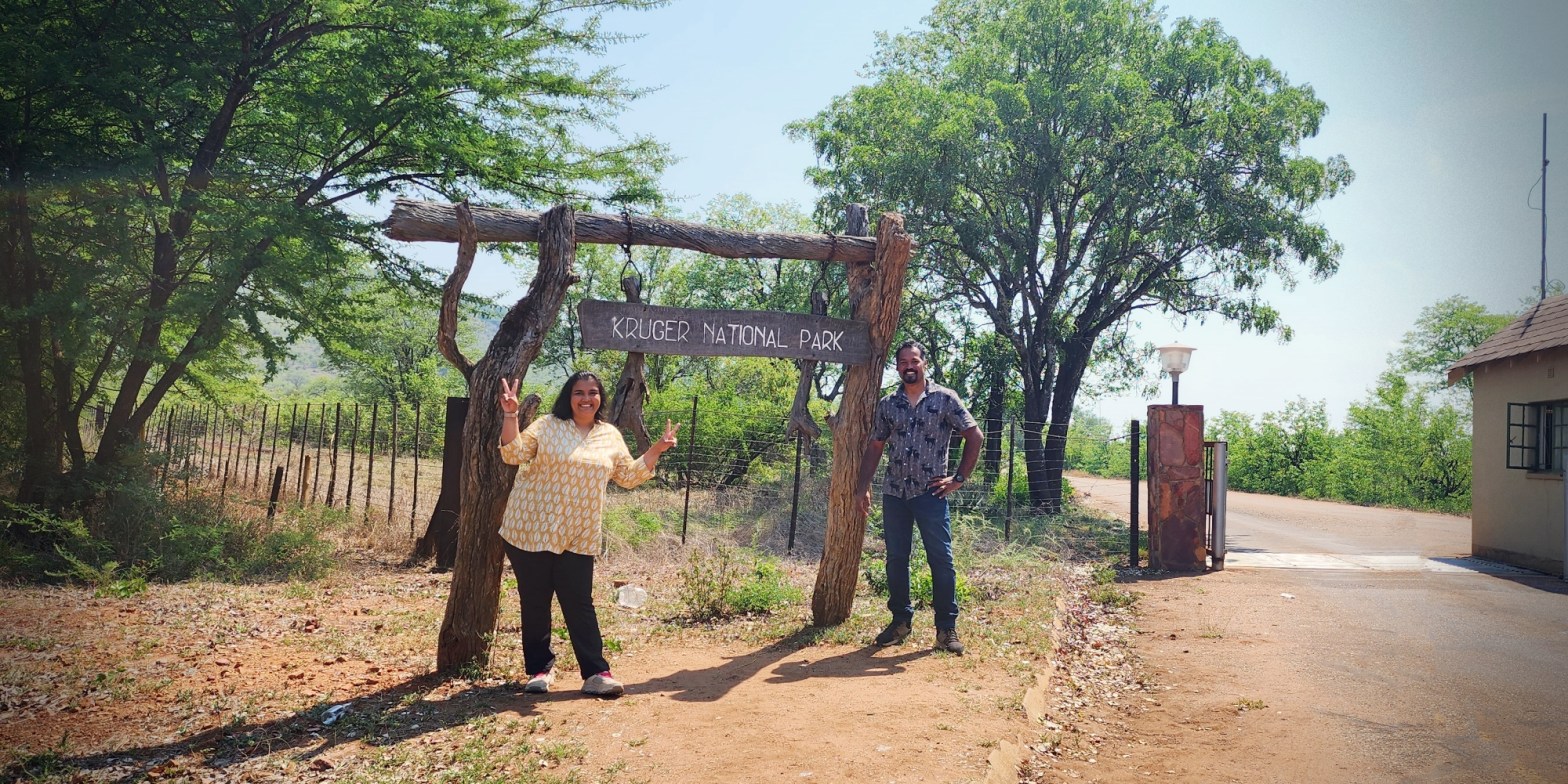
Kruger National Park (KNP) is the whole reason why South Africa was on our list for the longest time. The ease of African Safari is unmatched. The money’s worth is unbeatable. And finally, the adventures we had and memories we made were priceless. Its vast and varied landscapes and weather conditions from North to South and spectacular wildlife viewing make it iconic and deserving of at least a month of exploration if not more.
After two weeks spent on the southern coast of South Africa, we were ready for our two week bush* adventures in Kruger National Park, the crowning glory of South Africa.
*bush is a forest or national park/game reserve in Afrikaans. Exploring the bush or Going to the Bush is a major tradition in South Africa. Retired people have annual traditions of spending at least a month in the bush having a relaxed time. Young families make sure they spend a good amount of holidays in the bush to get children accustomed to the South African way of living.

Before we started to plan our stay in KNP, it was mandatory to imprint its map in our heads. This helped us better orient while planning the route.

Getting to Kruger National Park
For tourists like us who are short of time, flying to the airport nearest to KNP is the best choice. We could fly to Johannesburg and drive 5hours to reach one of the gates of KNP and maybe that would be cheaper. But at some point, we had to choose between time and money. We had to decide what needs to be saved and what needs to be sacrificed in order to have an efficient holiday itinerary. According to our research, all flights from George and Port Elizabeth went to KNP airports via Johannesburg. FYI, India – South Africa flights are cheaper if you book them to and from Johannesburg. They are more expensive connecting to any other city.

Johannesburg – KNP airports are connected by these really tiny baby planes. Except regular laptop bags/backpacks or purses, nothing else is permitted as cabin baggage. Even Sunny’s camera ATLAS camera bag had to be checked in at the last moment. The seats were small and not very spacious. Not very comfortable for tall-wide people. Food was served.

Timings and Seasons
A gentle reminder, South Africa is in southern hemisphere, so the seasons are reverse of what we have in India.
There was not much thought behind choosing November as our month of visit. That’s when we had a break in our projects at office and could take long leave. That’s that. But for a more conscious traveler, October and November are Spring. December and January are summers. April and May are autumn. June to September is winter. There are distinct seasons in KNP. Winters are cold and dry and Summers are hot and extremely wet. Spring and Autumn are transition times as usual.

Summers bring heavy rain. This results in flooding in the rivers. The grass grows longer and greener, making it a bit harder to spot wildlife or travel freely in the park. However oddly, it’s a preferred time to watch migratory birds and offspring of big cats and antelope. It’s also peak season for tourism, Christmas holidays locally and all over the world and all that.
Winters are dry with random thunderstorms once in a while, causing drought and forcing animals to congregate near waterholes. Dryer shorter grass means more chances of spotting wildlife. Bird-watching is restricted to residents mainly.

During our stay in second half of November, we experienced light rains maybe 3-4 days in total. Mid afternoons were hot almost everyday but time period and temperature of heat increased as we traveled north. Other than mid afternoons, the rest of the day and night were extremely pleasant/chilly. It would extremely cold post rains.
Birds and animals were courting and making nests getting ready for summer monsoons to procreate when food would be abundant.

Season regulates the KNP main gates as well as SANP rest-camp gate timings. The rangers of the park are extremely strict about the timings. Wherever we were at the end of the day, we had to reach our rest camp gates before closing time. No excuses, late incoming means fine. Argue, and you will end up in Skukuza jail.

For November, KNP main gate opening time was 5:30am. SANP rest-camp gate opening time was 4:30am. Unfortunately, lazy as we are, we were never able to get out of camp gate before 5:30-6am. Believe it or not, people line up at the gate before it opens to be the first car out. Hmmf.. maybe next time we will push ourselves more to be efficient. Earlier you are out, higher are the chances of encountering resting big cats on the ‘H’ tar road or a pack of African wild dogs out for hunting breakfast.
Closing time for the KNP main gate and SANP rest-camp gate was 6:30pm. It was always a rush in the last half hour. We tried to do smaller loops around sunset. This way, we were inside the gates by closing time.

As the days become shorter in winters, the gates remain open for lesser time. The most obvious reason being the only explanation. No authorities can keep a track on visitors after sunset. Staying in the SANP rest-camps gave us the opportunity to explore the nocturnal life of the national park by joining the guided night safaris.

Planning the basic itinerary
Ooh, the exciting part!
There are around 10 KNP main gates to enter or exit the park, including a couple which are border crossing gates into Mozambique. Grandest of all gates is Paul Kruger Gate which takes you directly into Skukuza, headquarters of the national Park. Skukuza is a township in itself and has everything a small town would have right in the middle of the national park. It has it’s own police station, jail, airport, hospital and even a golf course.

Landing in Skukuza would have got us right in the middle of the park. It would have made a great starting point if we had decided to explore the park in a circuit. However, we had chosen to do a unidirectional South to North roadtrip to get a taste of everything this park had to offer for our first trip. We decided to fly into Mbombela/Nelspruit from Johannesburg and enter the park through Malelane Gate. We planned to exit through Punda Maria Gate and then drive back all the way to Johannesburg.

Why South to North and not reverse you ask? There were two reasons.
- There is no airport close to Punda Maria Gate (Northern section) so, to start from north is nearly impossible. We had 3 choices, either fly into Skukuza, Hoedspruit or Nelspruit. Skukuza (Skukuza) and Hoedspruit (Orpen) are better to access central Kruger which is most touristy section of Kruger. SO, Nelspruit was best option for us which was just an hour away from Malelane Gate (Southern most Gate to Kruger)
- We were here in mid November. The migratory birding season for the summer was just about to begin. Northern Kruger is known for best bird watching experience. So we thought of starting from South. By the time we reached North, chances of seeing more migratory birds would increase.

The were two drawbacks to this plan.
- As we approached the end of November and also towards northern Kruger, summer temperatures had started soaring. It was getting hotter by the day. North Kruger is part of the dry arid shrub lands. It is, of course, hotter compared to the green thick woodlands and grasslands of central and southern Kruger.
- This one, we knew in theory but dint realize the severity of it till we were actually in the park. To scale the length of the park we booked four rest camps which covered each region. We underestimated and miscalculated the actual time it would take us to travel between the camps. Mind you, actual time is very different (and much more) compared to google map time. The speed limits are low on main roads. There might be a sighting on the way which you would not want to miss. An African Elephant might block the road. The weather might change or, worst of all, you might experience a vehicle breakdown. Don’t forget to consider the ranger in you who may get attracted to a certain side road and detour into winding dirt tracks trying to feed the curiosity. Boom, 1 extra hour gone, very easily. BUT I guess if we were going again for our ‘very first’ trip in KNP, we would still take the same decision. We would still traverse it. We enjoyed every bit of it, that’s just who we are. Over ambitious explorers.

All said and done this is how our itinerary finally looked like –
Enter from Melalane Gate (South of the park).
Stay in Berg-en-dal rest camp – 3 nights.
Stay in Satara rest camp – 3 nights.
Stay in Letaba rest camp – 3 nights.
Stay in Punda Maria rest camp – 3 nights.
Exit from Punda Maria Main Gate (North of the park).
Check Kruger National Park map to understand the locations.

Booking Accommodation
Days can get severely tiring during self drive safaris in KNP. A good safe room and a comfortable bed is all what we needed at the end to crash. There are a lot of choices when it comes to accommodations in KNP. The park caters to all types of tourists and wildlife enthusiasts. Everyone is sure to find there type and in their budget.

A lot of tourist decide to stay in the resorts outside KNP along the borders. They come into the park either by resort’s own safari vehicles like we do in India. Alternatively, they come by their own rented cars. There are resorts with levels of luxuries and budgets. We found that these had two main drawbacks.
- These resorts are outside the national park and to enter the park visitors have to come through one of the main gates. These KNP main gates are far away from the park’s main circuits and rest camps/picnic spots. It may take visitors longer to get to the productive hot-spots and waterholes compared to visitors already staying inside the park.
- The main gates open half hour later than interior rest camp gates. So, even if they are first to enter the park they are still late compared to tourists living inside the park. The main gates close half hour before interior rest camp gates too so the day trippers have to rush out at sundown, as they have a long way to go to exit the park before it closes. This often results in missing the golden hours of dusk and dawn when wildlife is most active.
- While entering the park, they need to wait at the gate to buy the daily permits/pay conservation fees every day they want to enter the park which adds to the wait time outside the park.

Inside the borders of the park, there are two types of accommodations. Privately owned expensive resorts and South African National Parks (SAN Parks)/Govt. owned rest-camps.
The resorts have their own safari vehicles and package usually includes guided safaris and sundowners. We chose to stay in SAN Park rest-camps which was the best decision – budget-wise and otherwise. We could see that they were recently renovated and were in excellent condition providing all necessary human comforts including laundromats.

Be aware, that accommodations at SANP rest-camps get booked up very early. We did our bookings almost 6 months prior to our trip and got what we had hoped for. Prime locations and prime dates get booked a year in advance sometimes.
Each SANP rest-camp is an electric fenced compound with 4-5 types of accommodations ranging from all inclusive multiroom cottages to open air campsites with common bathrooms. Just choose your pick from SAN park official website here, as easy as it gets. Rates depend on the location and type of the accommodation. Central Kruger is most expensive and north the least.

Similar to govt. tourism board managed resorts here in India, these rest camps are always made on the best spots – with the best scenery or a waterhole where we were always sure to spot wildlife at close quarters.

Rest camp bookings can be modified on the go if there is availability and you pay the difference. While packing for the SANP rest-camps, make sure to pack multi plug extension cord as most rooms had only one plug point.
Tip housekeeping team 100-200ZAR, they wash the utensils and keep the room safe and clean.

There are multiple activities for the interested inside the rest-camps. Some days we just wanted to chill and wanted to take a break from the forest and driving, those days we spent wandering in the rest camp checking out museums, walking trails, clicking birds observing insects, small animals and checking out the unique trees or just do some laundry in the common washing machines. Restaurant and common areas are great place to just grab shade and read a book with a cocktail. All SANP rest-camps have good sized swimming pools to spend hot afternoons.

Permits and fees
While entering the park we were given a permit slip. This slip was proof of our existence in the park. It had to be kept in the car at all times safely. If incase we were to leave the park through the same gate or another we would have had to get another permit to enter the park again. It included info on number of days we had planned to stay, where and vehicle number plate details. There is no separate fee for this permit.

A conservation fee needs to be paid for everyday spent in the park. It can be included and paid for during booking of the SANP restcamp accommodation via SAN park official website. Day-trippers need to pay this every day they enter the park.
This conservation fee is waived of if you have a International All Park cluster WILD card . This can be purchased once and renewed annually. Buy this before booking accommodation.

Food and Beverage facilities
*Disclaimer – Both of us are non vegetarians and not fussy about food till it tastes nice. Both of us consume alcohol, not like alcoholics, but enough to enjoy a relaxed evening. Following learnings, observations and opinions are based on our personal experience. We do think that although there were vegetarian options everywhere, it would be restrictive as South African food culture is heavily meat based. For the fussy eater, it may even get more difficult to handle the budget.
While researching for our trip, going through blogs and YouTube videos, we did not get a very clear picture of what’s available to eat in the park. We were also unsure about what food items we should buy outside the park and what we should carry from India. As young Indian tourists with tight budget, it was very important for us to know our options.

The online info is more about camping and barbecuing (Braaiing in Afrikans). I don’t think many Indians are interested in barbecuing daily or even know how to do it, us included. Neither were we going to live on salads or tryout ingenious ways of cooking out of a box. We did not really want to spend our vacation thinking about what to make and how to make for three meals. We could not have all three meals in the restaurant too for two weeks. Unfortunately, lack of info resulted in us over-packing and exceeding our luggage weight limit.

Let’s just say expensive lessons were learnt during our trip and now we are more aware of the options and prepared for our next one. Each SANP rest-camp has a restaurant which is priced as per upper average restaurants in India. They mainly serve South African & African-Malayan cuisine. Dinner everyday in these restaurants did not effect our pockets too much.

Each SANP rest-camp had their own grocery/general store. This also doubles up as a souvenir store. It has all daily use items including essential food items, utensils and toiletries – priced same as India. Almost all picnic sites had similar stores to stock up on car snacks and munchies. Picnic sites almost always have a well equipped café too. These were very economical – coffee and bakery items priced similar to cafe’s in India. These were best for breakfast, mid morning snack or lunch. It is anyway advised to halt at all picnic sites for washroom breaks and avoid emergencies in the forest on some lonely road. There are no restrictions at these picnic sites, get your own food or buy there – they don’t care, just don’t feed the monkeys or other wildlife.

P.S = Alcohol is available in SANP rest-camp shops as well as in restaurants, but not in picnic sights. Consumption is only allowed inside accommodation or a restaurant. Day-trippers are not allowed to buy alcohol in stores or bring in alcohol from outside. They can consume though at the restaurant.

We had packed MTR’s ready to make Poha and Fortune’s ready to make Khichadi from India which was a good choice for breakfast and dinner for some of our days, but the packets although light weight, were too bulky to carry. We could have easily reduced some packets and would have managed with bread, eggs, meats and various spreads which were easily available in SANP rest-camp stores at costs similar to India.

Every room we stayed at had at least a kettle. We could make coffee and tea. We carried it in our thermos to have it out in the bush during our morning self-drive safari session. Some of our accommodations had utensils and fridge and hotplate/microwave and some dint. Perhaps, we could have been more careful when we were booking accommodation, paid a little bit extra for that convenience everywhere.

Self – Drive Safari
Lots to talk here.
It was an experience like never before. It left us wide eyed and wanting for more. It is impossible to have such an experience so conveniently and so well managed in any other country. Even though we were amongst the wildest of wildlife, we were having the time of our life.

KNP is best explored in a self-drive rental car, we rented ours from AVIS and picked it up from KMI airport, Mbombela/Nelspruit. This was our indulgence for this part of our trip. We paid some big bucks to rent a higher car (Hyundai Venue) with automatic transmission. The space, suspension and comfort of a bigger car were a boon when we spent the whole day in it traversing through trails and tracks of KNP. The height of the car also helped us spot animals beyond the tall grass in some cases. Skukuza has it’s own AVIS store and also the only one in the park. They were our first responders in case of car breakdown, we had kept it’s phone number handy along with our SANP rest-camps number.


South Africans drive the same side as Indians and we do not need an international driving permit to drive there. Sunny was the designated driver and had kept his camera gear on co driver seat. I sat behind diagonal to him with my camera gear, snack basket and bird/wildlife books. This arrangement helped us cover 180degrees of scanning range and photograph 360 degrees.

Petrol pumps and carwashes are available in all big SANP rest-camps through out the park. It’s a good idea to never let the tank go below half mark just to avoid sticky situations. It is advised to keep the air a bit low in the tyers to drive smoothly on different types of terrain in KNP. There are attendants at petrol pump like in India and easily payable by cash/Forex.

We booked morning, evening and night safaris on random days. Some we had booked before the trip and some we added on spot later. Off-course, on spot booking is allowed but is subject to availability of vacant seats. These were similar to our camper van safaris in India and gave Sunny a break from all that driving. The jolly guides – also doubling as drivers on these trips were excellent and had a lot of knowledge to share about the forest and all the beings in it – plants, animals, birds, insects, reptiles and amphibians. They made the 2-3 hours out in the wild very enjoyable, irrespective of we saw anything interesting or not. Best to tip them 50-100ZAR per person at the end of each safari for their special efforts/entertainment.

It’s best to buy Tinker’s Kruger Park Map guide at the first opportunity. We bought 3rd edition of this book as soon as we reached our first SANP rest-camp. It is readily available in all SANP rest-camp stores in KNP. The maps and information provided in this book are spot on. The in depth info on each SANP rest-camp and different regions of the park, the roads and distances etc.., the best routes and circuits to take, spotting suggestions and most importantly all important phone numbers are given in this book. This book was the perfect guide during our stay in KNP. We referred to it religiously for every small thing – it’s the best!

There are 2 types of roads in Kruger National Park open to general public with general cars. ‘H’ are tar roads which connect all KNP main gates and all SANP rest-camps with another. Speed limit on these are 50km/hr. We mainly stuck to these roads and got best sightings. They are wide, well maintained and usually have clearings on both sides.

For the more adventurous traveler – there are ‘S’ roads, these are dirt roads. They are well maintained but are highly weather dependent. Trees and shrubs are usually till very edge of the road, which can be a risk with crossing wildlife. We tried to avoid these roads as much as we could unless they are highly recommended in the guide book or there was a waterhole on them etc. Specially on the the day we were changing camps. While changing camps from Berg-en-dal to Satara, we learnt it the hard way to never divert onto these if you have to reach anywhere on a specific time. They are longer and slower.

SANParks is an old and wise organization. They have mapped and marked the park well. There are signboards at every junction and every few meters. Most of the times we were okay using offline google maps and map from Tinker’s guide book. But it was re-assuring when we crossed a milestone/signboard confirming that we were not lost and were on the intended path. Roads can be confusing and sometimes a wrong turn can get you in a loop. It helped keeping a note of the milestones we crossed specially in northern KNP where crowd was scarce and sometimes we would be the only car on the road for many kilometers.

Try wearing loose airy cloths during your stay in KNP. Sitting and driving almost the whole day can get uncomfortable in tight clothes. There is no real need to wear camouflage cloths unless you are going to walk in the forest.

Never drive over dung. Mostly you would find African buffalo or Elephant dung on the road and smelly as it might be, its source of nutrition to many beings in the forest. Driving over dung would result in killing these innocent insects who are just trying to clean the road for you while feeding themselves. How noble! Even the safari drivers can be seen precariously dodging the dung cakes as much as they can.

There is an unwritten tradition in Kruger National Park to nod and wave at every passing car in the park to greet the fellow tourist or wildlife enthusiast including the passing safari vans/jeeps. It’s a friendly gesture that’s too cute to be true but encourages communication between people otherwise unknown to each other. For that second, you are in a bond where you are free to convey information to a stranger. You can share if you have spotted anything interesting or if your car is giving you trouble or if there is anything to watch out for on the road from where you are coming and the other person is going etc.. Its a friendly reminder that you are not alone in this wild forest. It was really cool and we really enjoyed the sense of comradeship in all safari goers.

Sometimes people would stop to talk to us while we were trying to photograph a bird with a lot of difficulty. We did not want them to disturb us. They would curiously stare at us and scan our point of view expecting a lion or something. So we found this magnet (see below) for our car from the SANP rest-camp store and hoped people would respect it.

People, if given a chance would always stop and share exciting spotting and bush gossip on how bad or good the day has been. At other times, we would get stuck in traffic jams where people were either taking chances photographing a posing giraffe of some other animal or exchanging notes on which road was productive to scan that day or where did they see a pride of lions on a kill yesterday or where did they narrowly escape a crazy tusker some hours back or whether or not a leopard is sleeping in the tuft of long grass next to the road.

Never get down of the car unless you are in a designated area like a picnic point, panorama viewing area or a high river bridge. When in doubt, check for boards. These areas are not fenced so everyone needs to be on 100% alert and check surroundings before posing for pictures.

DRIVE slow. ALWAYS. Leave early if you need to reach somewhere. Remember, National Park belongs to the wildlife, we are guests. Many times we observed tourists driving rashly even on dirt roads and honking at Giraffe, Zebras and Impalas. This insensitivity is what makes animals anti-humans and shy. Don’t be that guy.

Encounters with wildlife
Watching wildlife and birdlife of the forest is the icing of the self-drive safaris in KNP. The whole cake is as barren as it gets. Almost 70% of the day we did not see much or anything at all. People who only look for the big 5 have their percentage of barren day even higher. Being birdwatchers and wildlife photographers, we had an advantage. We almost always had an interesting spotting which most of the visitors overlooked. A zebra is a zebra just like the last zebra for other visitors, but we would most certainly stop to get some action photos of it playing with its mates or hosting an unusually large number of balancing Oxpeckers on it. Days just flew by for us. Lesson to be learnt, enjoy the cake as a whole not only the icing 😀

Oh, and that reminds me… always ALWAYS check Tinkers sighting board wherever you stop. Its an unofficial guide, a clue to treasure hunt of sorts of what people saw where. Feel free to add in your own contribution if its been a lucky day.

Some times there are tiny little creature on the road which need as much attention from the visitors as the African Lion. It always pays to drive slow and keep your eyes peeled to enjoy these beautiful creatures in the forest.

Most important point. Keep a safe distance between car and animal. For animals safety as well as your own. Any of the big cats or elephants, rhinos, buffaloes, hippos can break the car at will. Don’t do sudden car movements or honk. Stay calm and keep your car speed stable giving them enough space. Best is to just stop, make sure your car is locked, pull up your window and enjoy the sighting. Photograph using long lens!

Always stay within the outline of the car. Animals in KNP are used to vehicles since birth. Please note, they are used to vehicles and not humans. Don’t lean out of the window, open the door or pop out of the sunroof. These actions break the vehicle silhouette and alert the animals almost always attracting them or sometimes chasing them away.

Adult bull African Elephants – African Elephants deserve a separate section. Going into the national park, we mainly feared venomous insects and snakes in general. Not a big fan of random bugs, but we can survive them. Watching African elephants on National Geographic and comparing them to our very own Asian elephants is a fool’s error. I don’t even have a word to describe the level of our fear when we crossed our first adult male gigantic African Elephant at close quarters. With their special muscle structure and camouflage, they are one of the sneakiest creatures in the forest. They are very easy to miss unless they are right at your windowsill while munching away fresh Mopane leaves coolly at the side of the road. It got some being used to.

As time passed, we slowly learnt how to go about the whole matter. We started seeing the signs on the road. Broken branches and elephant dung, clear sign of elephant’s presence. A full herd is no problem if you keep your distance and don’t give speed jerks. If you see a group of bulls, that’s also fine. But a lone one – requires an appropriate reaction, below info is based on how we responded in different situations. It may or may not be the correct way, but hey! there are no official guidelines for this kind of stuff except ‘stay away!’
- If the bull has his back to the road and busy eating just drive, don’t stop keep a steady but fast pace.
- If he has his face towards road and calmly eating, same deal.
- If he is in musth, flapping ears or doing fancy tricks with his trunk, trumpeting – that’s when you be extra cautious and calm. Go slow and steady without any sudden movements. Automatic transmission car is a must.
- If he is on the road, ahead of you going away from you. Don’t overtake him, match his speed and let him lead, he will get off the road sooner or later. Change course if you can.
- If he is walking towards you, just start reversing, match his speed and pray that he gets off the road sooner or later. Change course if you can.
- Photograph them only if you are 100% sure you are out of harms way. Again, use long lens!

The ‘H’ roads are still wide and almost everywhere there is a clearing on both sides so you can see these bull elephants from a distance. But on ‘S’ roads, game is totally different. Tuskers were the only reason we reluctantly avoided ‘S’ roads. Everyone says they are more productive. But we feared crossing African Elephants too much to take chances. African Elephant, specially a bull is to be feared above all in the park.

Always keep an eye on the map for waterholes and be extra cautious around the region for crossing elephants.
Learn the signs of bull in musth and learn to differentiate between male and female elephant (spoiler, both have tusks!) before you go. By the end of our trip our fear had settled (not gone) and we were slightly more confident in handling bull elephant encounters. But the fear of snakes and venomous insects was still intact – till we exited the park, even though we dint see any.

Caution and Safety
During and before our two week stint in KNP we observed other visitors who seemed to be pro in handling stresses of living in a forest and have been doing it for years. We chatted around with guides and other officials/staff members of SAN parks. Read books, articles and posters. We wanted to be as safe as we could during our stay to maximize our vacation in the bush. Off-course we had an open mind for adventure, challenges and surprises but we like being over cautious abroad. Apart from being alert in general and following usual precautions, we picked up some additional pointers during our stay.

Rest camps, as mentioned earlier are protected by electric fence. Yet there are many stories of animals strolling in through it or through the gates. Well, there are bound to be loopholes. Best thing to do is always stay alert, carry a head torch and never feed an animal inside or outside the fence. This action leads to misbehaved animal and eventually ends in them being shot down because of human stupidity. Hyenas and Jackals regularly walk along the fence on the outside looking for scraps of meat visitors throw. Vervet monkeys and Chacama Baboons are notorious and dangerous just like our Indian Maquaqs/Langoors. And just like their Indian counterparts, they thrive in SANP restcamps.

Most picnic areas are not fenced at all and there is nothing keeping the animals at bay except maybe noisy tourists. Refrain from wandering too close to the borders of the clearings, try to remain in central crowded area of the site. Avoid being alone in a picnic area. Afsaal picnic sight, one of the best picnic areas is located between Berg en dal and Skukuza – the busiest route of the park. It is one of the most popular picnic site among tourists and big cats alike, if you know what I mean. 😀

Make sure you have the top most insurance on your rental car and it’s the best quality/maintained you can afford. No skimping there. Your car can easily make or break your self driving experience in KNP. We can not emphasize enough on getting an automatic transmission car. Some situations will make the driver nervous, we don’t want a stalled car to add to that. We had excellent experience with AVIS, and can not recommend them enough. They are best for car rental in South Africa. Goes without saying, petrol tank should never cross half mark and first aid, snack basket, water bottle and phone battery must always be full for emergencies.

Keep tinker’s guide book handy at all times, it has all essential info and phone numbers. MTN sim does not work anywhere in KNP. As you go north, wifi in common areas of SANP rest-camps also gets weaker. Vodacom sim or getting international travel activated in Indian Vodafone sim is a better choice.

Alternate itinerary ideas
As we travelled from one end to another, we experienced different landscapes and ecosystems from more green woodlands and grasslands in the south to dry desert-like shrublands in the north. This was our first trip to KNP and we wanted to taste the essence of the whole national park. Our itinerary covered broad sections of the forest and our rest camps were far apart. Yes, to most this would look extremely exhausting and we agree .. it was. But it made us see a wide spectrum of what this renowned national park offers. Best of all, it has helped us determine how we should plan our future visits better and more efficiently.
Next time we would concentrate on one of the sections. For example,
Fly into Skukuza > Lower Sabie > Crocodile Bridge > Bergendal > Flyout of Skukuza
OR
Fly into Hoedspruit, enter from Orpen > Satara > Olifants > Letaba > Mopani > Exit from Phalaborwa and fly out from Hoedspruit.
Check Kruger National Park map to understand the locations.

Ah, well – we dream of getting back to Kruger National Park very soon. Exploring Kruger National Park is not a task for any finite time. Apart from the fact that it’s addictive, it’s HUGE! It is almost as big as some countries and some bigger states in India. We met many people during our stay and have seen videos of many enthusiasts who came to KNP as a one off trip, but now return to it annually like a family tradition. We think by the end of this trip, we had slowly slipped into the same category and making plans and itinerary for our next trip while we waited for our flight to go home. But next time, we will try to visit in dry season.

Important links to help plan your trip!
https://www.sanparks.org/parks/kruger/useful-information/visitor-tips
https://www.krugernationalpark.org.za/
That’s all folks! All we know about how to plan a self drive trip to Kruger National Park. Hope we have inspired you to plan your self drive safari in Kruger National Park When (you are) on a Break!
 When on a Break!
very informative n helpful for people planning to visit Kruger..it’s true there is very less information regarding stay n amenities at n around rest camps on social media…though long loved to read the blog…thanks for the details
Very informative and helpful for anyone planning a trip to Kruger National Park. It’s true that there isn’t much information online about the stay options and amenities around the rest camps, so this blog was really valuable. I truly enjoyed reading it—thank you for sharing such detailed insights!
Thank you for your appreciation. 🙂