Trip date – Beginning of November 2023
The coast that runs between Simon Town till just beyond L’Agulhas is known as Cape Whale Coast. It is the best place to spot whales from land as they come very close to the shore. Yes, we did see some whales even beyond the Whale Coast, but this section has more probability and better sightings. We covered first half of this road-trip when we traveled from Simon Town to Hermanus covered in this blog here. This blog is a continuation as we head on further east to explore the rest of the Whale Coast.

There are two ways to travel in the region between Hermanus and Wilderness (our next accommodation), South Africa –
One is the usual N2 which runs between Cape Town and Durban (goes over Hermanus and under Wilderness) – This is a great 4-lane high-speed highway running wedged between mountains and farmlands that can get you to George in 3 hours, big town next to Wilderness. Multiple side roads (R – reginal roads) take you to different towns, for example R319 is a detour to see Cape Agulhas which may add another hour or so.
The second is for adventurers like us, especially if you are a birder. This route goes along the coast via multiple regional road and can be done in a day or divided in a couple of days. If you do it in a day it can take close to 6-8 hours depending on how many times you stop in the way. This is also a great way to see some very cool spots like Danger Point, Elim and Cape Agulhas etc… Needless to say, we picked this route.

Below is an account of our experience with the second option 🙂 – but done in a day as birdwatchers, hmmf!
As we exited Hermanus, we took the R43 to Gaansbai via Stanford. The road goes around Walker Bay Nature Reserve and had some of the most beautiful views of mountains shrouded in clouds on one side and deep blue Atlantic ocean on the other. This road goes between a nature reserve so it’s quiet probable to see a passing Leopard or a Caracal or some kind of Antelope around, drive safely and keep a lookout!

Closer to Gansbaai, the Nature Reserve started to transform into large farmlands with large herds of cows and horses. Gansbaai is extremely famous for its high density of sharks and is a top spot for spotting and cage diving with them, mainly with the Great Whites. Huh, as much as it saddens me and as much as I question the ethical practices while doing this – it’s happening, and it happens here more than anywhere in the world. Thankfully, at least all types of Sharks are protected under South African law.

Gansbaai is a small fishing town with the biggest canned fish factory and apart from tourism, the economy is based on fishing, Abalone and Kelp farming. Just a couple of months before our visit, this town had hit headlines when two notorious and rogue Orcas named Port and Starboard killed almost 20 sharks for their liver chasing away most big sharks out of the bay (they are still on the mission as I write).

There are hundreds of Whale Watching tours throughout the coast but only a few claim to be sustainable and follow the fair trade policies, the most popular in this area are Marine Dynamics. They do Whale Watching and Shark Cage Diving (hmmf!, it’s the thing to do when in Gansbaai) tours to the Dyer Islands.

A couple on minutes beyond Gansbaai is Danger Point marked by it’s beautiful octagonal and very much operational lighthouse, marking one of the most treacherous sections of the South African coastline. This is where centuries ago the famous HMS Birkenhead sank.


Just before Pearly Beach on R43, we drove inland through huge farmlands and small townships towards the historic town of Elim. The route was extremely pretty and the vast grasslands/farmland gave us excellent birdwatching opportunities. Elim is famous for its roofing craftsmanship and the local community runs cultural tours showing their roots and history, unfortunately, (or fortunately) all our time was occupied spotting birds and the patch which should have taken only 45mins took close to 90mins.


A bit beyond Nuwejaars Wetlands Special Management Area is the dirt road which goes around and between various private nature reserves and farmlands towards Cape Agulhas and Agulhas National Park. This dirt road in itself is a birder’s paradise. We took our time slowly meandering through these vast expanses of grasslands/wetlands and kept our eyes focused in search of new birds. We were a bit worried at the back of our minds if we were lost or going the correct way as this road was such a contrast to the roads we were used to so far in South Africa. Worry not, this is the correct way to go especially if you are a birder – you will not regret it.


The dirt road connects to R319 just before Struisbaai, a town before L’Agulhas. We were short of time and missed it. If you visit this town, don’t forget to say ‘Hey howzzit’ to Pierre at the harbor for us! The towns of L’Agulhas and Stuisbaai are dotted with white houses and hotels giving a very beach town vibe. They are not very crowded and preserve their old worldly charm. Cape Agulhas is the gem supreme of this road trip. It is outside the usual tourist circuit. There is no ‘easy’ way to get here. This place is usually only visited by locals or some very dedicated travelers.

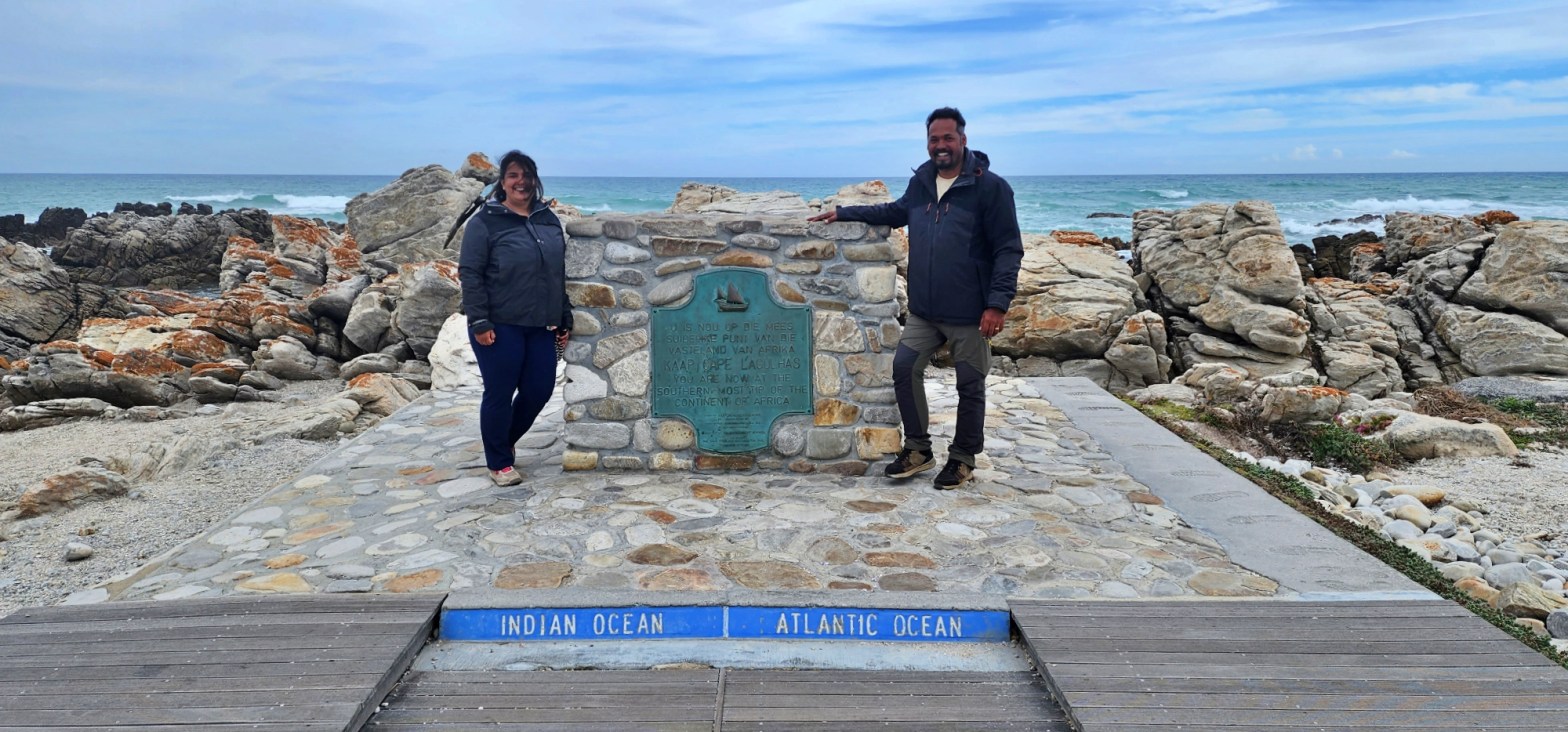
Cape Agulhas is the geographical southernmost point of the continent of Africa. Yes, read it again if you need to _ it’s not Cape of Good Hope. To tell you the truth, its not even a fraction of how dramatic Cape of Good Hope is – yet, it is one of the most unique places to visit.

This unassuming, non-touristy, super windy, rocky beachfront is where the cold Atlantic Ocean (Benguela current) meets the warm Indian Ocean (Agulhas current). This mixing and merging makes it one of the best places to go fishing. But it is the worst place to be on a boat or ship. Very frequent rogue waves occur here, and the ocean is quite shallow and rocky. Irony huh? It’s a graveyard to approx. 130 ships in the past.

Cape Agulhas is also called Cape of Needles. It got this name because it’s here where the compass needle shows true north – the compass needle aligns with magnetic north. Some say the name was given due to spiky rocks and shallow waters where reefs would be damaging. I personally think the name was given due to cold winds which were poking me like needles through my jacket!!!

R319 goes straight into the Cape. Entry to Cape Agulhas is marked by its operational lighthouse. The lighthouse stands strong and does its best to guide the ships away from the shallow and treacherous coastline. Visitors can walk up the lighthouse and also visit the very best museum at its base. Unfortunately, we reached here very late compared to what was planned and did not go up to the lighthouse.

Further down the road was the parking lot (parking is free, a customary tip to the caretaker is advised). From there, the boarded walkway starts directing the way to the ‘Southernmost tip of Africa’. Both of us were overwhelmed by the feeling of achievement… or was it the overpowering cold wind?? Ah well, we’ll never know. We just know that we were extremely happy to be here…and extremely lucky.

The boarded walkway extends further into the Agulhas National Park. It goes over the Fynbos bushes and other unique coastal plants thriving in this area. It goes around multiple sights and spots like the a cool looking map of Africa. It has multiple viewpoints and benches to enjoy a leisure time. R319 goes all along this boarded walkway till the official entrance of the park.

Overlooking at the vast ocean, it’s all left to the imagination. One can think about all the party of colours and marine biodiversity thriving underwater. This diversity exists due to the mixing of the two currents. Oh, and then a tiny thought – we were a bit closer to Antarctica. There is nothing stopping us from touching it. All we need is super human strength and maybe gills or wings😊 .

On our way out, we stuck to R319 till we joined back onto N2. On the day of our travel it was extremely clouded and a small storm was predicted. We were still 3 hours away from our accommodation for the night. We didn’t want to be on the road when it got too dark. So, we were in a bit of a hurry. Sun was setting and dark clouds were rolling in but we had our very best sightings on this road.


The vast farms on either sides were such an unusual sight for us Indians. We do have fields and farms here in abundance. They are medium to small patches. There is a lot of human activity going around. BUT these were sprawling across multiple hills. ‘Huge’ is an understatement. No humans in sight, only these big agriculture related vehicles for harvesting and irrigating etc…


Albertinia, a small town along N2 just before Mossel Bay is a cool stop to buy some herbal skin care as it’s a hub of Aloe Vera farming in South Africa.

Afterthoughts and ranting.
The regional roads in South Africa have pretty high speed limits (at least compared to India). These speed limits apply even when going across a national park or farmland. Wildlife roams freely in these areas. The traffic is scarce but people drive on extremely high speeds. This made it very difficult to do birdwatching. We were also short of time. We could not afford to take multiple stops.

On high speed, we realized that we spotted a bird or an animal too late. We were already a mile or so ahead. By the time we took a U-turn, it was gone! For instance, we did not believe our luck when we spotted a Caracal. It was slyly walking in one of the harvested fields. By the time we turned back, it had disappeared behind long grass! Such a rare sighting, but we were unable to photograph it 😦 . Fences with loose barbwire run along most farmlands. The fixing poles seemed to be the favorite perching spot for birds of preys and other grassland birds.

The biggest regret from this part of our vacation was not planning to stay in L’Agulhas or surrounding towns for a night or two. This decision prevented us from exploring the region better. We should have planned to stay longer. On this day we had to travel a long way to Wilderness. This situation meant we could not stop anywhere for long. We had to set our priorities. We even ended up skipping lunch, which we had planned in one of the cool restaurants in L’Agulhas.

By the time we reached N2 (just before Bontebok National Park), we promised ourselves to come back. We wanted to stay here for at least a couple of days. We would be free to loiter around on these regional roads. We could stop and chase every bird and animal.

This part of South Africa has an abundance of birdlife. It also has excellent places to explore. These places certainly should not be missed. Cape Agulhas certainly left us wanting for more. This place deserves a lot of time to explore its bountiful landscape and biodiversity.

To read more about the Cape Agulhas, South Africa – Check these informative website :
https://www.sanparks.org/parks/agulhas
https://opengeology.org/historicalgeology/case-studies/the-mixed-up-quartzites-of-cape-agulhas/
Hope this blog has inspired you to plan your trip to Cape Agulhas & Cape Whale coast, South Africa when (you are) on a break!.
Subscribe to our Youtube Channel to see the video of our trip with lot more information, photos and clips!
Subscribe to get regular updates on this blog & checkout our Instagram page for more of our photos during the trip.
 When on a Break!
omg so much of research goes in your planning …nice of you to share the minute details too to help specially the birdwatchers to plan will ..now cape Agulhas will surely be on the list of not to miss places.
Thank you , much appreciated 🙂